
County Veteran Service Fund shortfall still unresolved despite new report
 When the state budget was finalized last week, it maintained base funding for the County Veteran Service Fund (CVSF) — but left unaddressed the shortfall and funding complications that emerged last year. The program, which supports county veteran service offices assisting veterans with benefits, housing and transportation, continues to operate at existing levels while questions about how grants are calculated remain unresolved.
Earlier this year, legislative leaders indicated they preferred to wait for the Office of the Auditor General (OAG) to complete its review of how the Michigan Veterans Affairs Agency (MVAA) managed CVSF grants before making any changes. That report, released in September, provides a detailed look at how the shortfall occurred. The OAG found MVAA overestimated available grant dollars by relying on outdated “carryforward” amounts and lacked formal written procedures for tracking and recalculating awards. The result was a roughly $3 million reduction in planned grants to counties statewide.
The report also suggested several steps to strengthen program management going forward — including standardized policies for calculating awards, improved fiscal oversight and clarification in state law on how unspent funds should be handled each year, whether through a controlled carryforward or reversion to the General Fund.
With the OAG’s review complete and the budget process concluded, state officials and legislators are expected to continue reviewing these findings in the months ahead. The report provides a clearer picture of the administrative challenges and potential options to ensure more predictable funding for counties and the veterans they serve.
MAC’s preferred solution to the shortfall is House Bill 4423, by Rep. Julie Rogers (D-Kalamazoo), which would allocate $3.67 million to the County Veteran Service Grant Fund. However, MAC is willing to work with legislators on other options that would backfill the funding.
For more information on this issue, contact Jimmy Johnson at Johnson@micounties.org.
Dispute over mental health oversight heard in Court of Claims
 After a full day of arguments, the lawsuit over the state’s plan to rebid its Prepaid Inpatient Health Plans (PIHPs) wrapped up Thursday with no immediate ruling. Court of Claims Judge Christopher Yates said he expects to issue a decision early next week — likely Oct. 14 — through a declaratory judgment, rather than a temporary injunction.
The case centers on a Department of Health and Human Services (DHHS) proposal to shrink Michigan’s 10 existing PIHP regions down to three. Community mental health agencies filed suit and argue this move violates the state’s Mental Health Code and could upend Michigan’s community mental health system. Because PIHPs are limited by law to their current service areas, the new regional map would effectively block the existing entities from rebidding unless they reorganize under new structures.
DHHS maintains it has clear legal authority to set new regions and contract terms, even if the changes are unpopular. Judge Yates acknowledged both sides made strong arguments, noting he personally viewed the policy as “unwise” but suggested it may still be legal under statute.
Counties and local mental health boards continue to oppose the rebid, warning it could weaken local oversight and disrupt care for residents who rely on county-based behavioral health services. A final ruling next week will determine whether DHHS can move forward with its plan or must pause and revisit the proposal.
For more information on this issue, contact Jimmy Johnson at Johnson@micounties.org.
OAG report raises concerns over mental health rights
 A new report from the Michigan Office of the Auditor General found that the state’s Office of Recipient Rights (ORR) isn’t meeting expectations in protecting the rights of individuals receiving public mental health services. Covering 2021 through mid-2024, the audit concluded that ORR’s efforts were “not sufficient,” citing delays, documentation issues, and inconsistent oversight.
Nearly a third of complaints involving abuse, neglect, or serious injury weren’t reviewed for several days — even though ORR policy calls for action within 24 hours. The audit also noted late investigations, missing records, and untimely follow-ups. In some cases, incomplete monitoring and gaps in video or audio surveillance at state hospitals may have limited the ability to fully verify what occurred.
The report also found weaknesses in how ORR reviews local community mental health programs — an area with clear county-level ties since these systems handle the majority of mental-health-related complaints statewide.
MDHHS agreed with many of the findings and said it’s pursuing process changes and added staff positions to improve timeliness and consistency. The OAG also suggested that lawmakers may want to revisit sections of the Mental Health Code to strengthen protections and ensure accountability going forward.
For more information on this issue, contact Jimmy Johnson at Johnson@micounties.org.
Podcast 83: Ugly budget process works out pretty well for counties
A “pretty tumultuous” state budget process for fiscal 2026 ended last week in a flurry of action in Lansing ― and yielding a generally positive result for Michigan counties, MAC’s Deena Bosworth reported in the newest episode of Podcast 83.
“Our county commissioners stepped up to the plate and communicated with their legislators about revenue sharing and what that really means for county government,” Bosworth noted. “And at the end of the day, we ended up with the same number that we had in FY25 so we avoided a 12 percent cut to our county revenue sharing thanks to all of our efforts, which was awesome.
“But there was a lot more in that budget that I think we also have need to celebrate,” Bosworth continued. “We’ve talked for many months about the Public Safety Trust Fund bills and how monies would be set aside for public safety and for our members. … We’ve got a $2.5 million, one-time appropriation to counties they can use toward public safety. And then (there’s) an ongoing fund that is $11.6 million, so although our statutory revenue sharing was flat, there are these (wins).”
To learn more about how the budget benefits counties, particularly on infrastructure, watch the full episode by clicking here or on the image above.
Counties to receive significant road funding increase
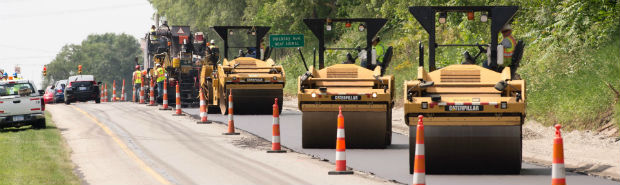 As first reported last week, a long-term road funding plan has been enacted that will bring millions of new dollars for county road efforts.
House Bill 4951, by Rep. Samantha Steckloff (D-Oakland), establishes the Comprehensive Road Funding Tax Act. The bill imposes a 24 percent excise tax on the wholesale price of marijuana, generating an estimated $420 million in revenue annually.
House Bill 4961, by Rep. Ann Bollin (R-Livingston), enables the decoupling of state and federal business taxes as a result of the One Big Beautiful Bill Act and establishes no tax on tips, overtime and Social Security. HB 4961 creates an additional $88 million annually in Corporate Income Tax (CIT) revenue, now earmarked for the New Neighborhood Road Fund (NRF) and dedicated largely to counties. The NRF will include $688 million in FY2026 and grow by $88 million per year until FY2030, when it reaches $1.05B in earmarks. The NRF will include marijuana wholesale tax revenue and CIT revenue, totaling $1.5 billion.
House Bills 4180-83 implement a fuel tax swap beginning Jan. 1, 2026, redirecting $1.1 billion in tax revenue to roads.
NRF funding will be mostly dedicated to counties, amounting to 52 percent of $865 million in NRF funding after monies are taken “off the top” for local bridges, local grade separation and transit funding. All in, counties will receive a 35.5 percent increase in road funding with the implementation of the FY2026 budget.
For more information on this issue, contact Samantha Gibson at gibson@micounties.org.
‘Resilient’ workshop will review Michigan’s economic state
 An Oct. 29 workshop will explore the “turbulent waters” that Michigan finds itself in economically.
“A More Resilient Michigan” will be held from noon to 6 p.m. at Michigan State University’s Henry Center in East Lansing.
“As Michigan and the nation face critical economic challenges, resilience and adaptability are increasingly critical to navigating issues like high inflation, anemic economic growth, affordable housing shortages, an uncertain federal government trajectory, depreciating public infrastructure and local government skilled worker shortages. Join MSU experts and state and local leaders to discuss current research on the issues facing Michigan and how it can help communities prepare for the turbulent waters ahead.”
The workshop includes lunch, refreshments throughout the afternoon and a light reception. While the conference is provided at no cost for attendees, registration is required. The event is co-sponsored by the MSU Center for Local Government Finance and Policy.
Among topics to be covered will be:
- Michigan economic forecasts
- House shortages and short-term rentals
- The impact of federal legislation on the state
- Water system finance
- Using AI for infrastructure management
CLICK HERE TO REGISTER.
MAC announces dates and sites for 2027 conferences
 The Michigan Association of Counties’ Annual Conference will return to Muskegon County in 2027, as county leaders will gather to help Muskegon celebrate the ongoing revitalization of the community’s waterfront.
The 2027 event will be held at the VanDyk Mortgage Convention Center and the Delta Hotels by Marriott on Oct. 4-6, 2027. The VanDyk Center opened in spring of 2021. The conference hotel was renovated in 2019, connects directly to the convention center and offers expansive views of Muskegon’s harbor, which is now a regular stop for three separate cruise lines.
“It’s been a long time since we’ve been to Muskegon, so we are excited to get this event lined up,” said Executive Director Stephan Currie. MAC’s last conference in West Michigan was in Grand Rapids.
Earlier in 2027, MAC members will again gather in Lansing for the 2027 Legislative Conference, April 12-14. The event will be held at the DoubleTree Hotel in downtown Lansing, just two blocks from the State Capitol and MAC’s offices.
For the latest news on MAC events, visit our conferences page. And a reminder, the 2026 event sites and dates are:
- 2026 Legislative Conference, April 27-29, DoubleTree Hotel in Lansing
- 2026 Annual Conference, Sept. 9-11, Grand Traverse Resort in Acme
 Staff picks
- Michigan’s juvenile incarceration costs soar as population, facilities plummet (Detroit News)
- Annoyed by junk calls to your iPhone? Try this new tech tip to stop them (MLive)
- (Washtenaw) County officials craft data center guidance for communities (Govtech.com)
- It’s Firewood Month: Do you know what’s in your wood? (Michigan Department of Natural Resources)