
Legislature will focus on economic development policies in waning days of 2025
 Testimony provided this week by Sen. Sam Singh (D-Ingham) focused on a new economic-development package aimed at reviving and modernizing Michigan’s business incentives. In a year mostly defined by budget negotiations, this proposal stands out as a push to reshape how Michigan attracts and retains good-paying jobs.
The package includes two companion bills — Senate Bills 472 and 473 — to reintroduce a payroll-tax withholding incentive program, similar to the now-defunct “Good Jobs for Michigan” initiative (2017-19). Under Singh’s plan, eligible employers could apply to receive a portion of income tax withholding from new or retained jobs, provided they meet certain thresholds.
The mechanics are as follows:
- Participating businesses would enter into written agreements with the state, and for a defined period — possibly up to 10 years — they could receive up to 100 percent of the withholding taxes from qualified jobs.
- Qualified jobs must meet wage and job-creation (or retention) thresholds tied to regional median income levels.
- For larger employment projects, the requirement would be higher; for smaller or rural counties, the wage floor is adjusted downward to reflect local conditions.
A key component important to counties is the requirement to have local governments weigh in on the businesses attempting to relocate and claim this incentive. The plan envisions a modernized business incentive mechanism that aligns with a broader push to attract advanced manufacturing, technology and high-wage sectors. By tying benefits to job quality and investment commitments — including a requirement that firms make a “hard investment” in state facilities, workforce or infrastructure — the plan aims to balance taxpayer protection with economic growth.
Singh argued during testimony that a well-structured tax-capture program can bring in investment, preserve existing jobs and lay the foundation for new growth in emerging industries. He noted accommodations for smaller counties and rural areas where median wages are lower, explaining the regional wage thresholds built into the bills.
After this week’s testimony in the Senate Regulatory Affairs Committee, the proposals now await further deliberation. The committee review is just the first step. If the bills pass the Senate, they must still clear the House and be signed by the Governor before becoming law. Given the tight calendar and the partisan splits in the Legislature, substantial revisions are possible.
For more information on this issue, contact Deena Bosworth at bosworth@micounties.org.
$1.47B in high-speed internet funding coming to Michigan
 A $1.47 billion public-private investment in Michigan’s high-speed internet infrastructure was announced this week by the Michigan Department of Labor and Economic Opportunity’s Michigan High Speed Internet Office (MIHI).
About $920 million in federal funding has been awarded to administer the Broadband Equity, Access, and Deployment (BEAD) program. This round of funding represents the single largest investment in high-speed internet infrastructure in United States history. In addition to federal dollars, Gov. Gretchen Whitmer has announced an investment of $550 million from the private sector in matching funds.
Per Gov. Whitmer, the latest BEAD funding is enough to connect almost 200,000 homes, businesses and institutions, establishing more than 31,000 miles of fiber-optic infrastructure over the next four years.
For more information on this issue, contact Samantha Gibson at gibson@micounties.org.
Podcast 83: Drone safety is focus of special episode
A start-up firm based in Detroit is now working with counties and other local governments to ensure that safety comes first in airspace increasingly filled with drones.
Michael Healander of Airspace Link spoke with MAC’s Samantha Gibson in a new special episode of Podcast 83 on his firm’s work and what the challenges are ahead for county governments.
“Our primary focus is government agencies,” Healander said. “Even though we have hundreds of thousands of commercial operators that use our system. Think of us as the systems to support who’s flying and the safety and security of our airspace.”
Airspace Link is a Federal Aviation Administration-approved UAS Service Supplier of the Low Altitude Authorization and Notification Capability (LAANC) and is approved to provide B4UFLY Services. Airspace Link provides airspace authorizations to both Part 107 Pilots and Recreational Flyers through the AirHub Portal application.
“The county is in a unique situation. I’ll give an example. Oakland County, in their drone program. They have the capabilities to have drones go out in an emergency and support search and rescue; it’s a very successful program,” Healander noted.
“So, we’re seeing some counties start to say, ‘Here’s a common network and platform that maybe we push down to our cities. And this is a really great opportunity for counties to take the lead, to be able to put it in a common system …”
To learn more, including details about upcoming federal funding opportunities for local governments, watch the full episode by clicking here or on the image above.
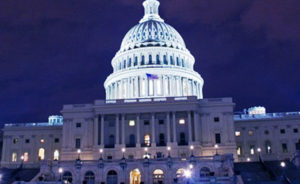
NACo resumes digital briefings on D.C. action on Dec. 11
Join the National Association of Counties’ Government Affairs team for week 13 of a biweekly series on key developments from the White House and Congress.
Discussions will focus on policies and actions that directly impact counties — from federal funding and regulatory changes to intergovernmental partnerships. Tune in for an inside look at how these evolving federal dynamics may shape county priorities, responsibilities and operations.
Click here to register for the Dec. 11 event, which will run from 3:30 p.m. to 4:30 p.m. Eastern.
 Staff picks
- Electricity prices jump after Trump rejects disaster aid for Michigan utilities (Politico)
- New Senate bill would reauthorize cyber grant program (RouteFifty)
- Even as SNAP resumes, new work rules threaten access for years to come (Kaiser Health News)
- Suicide rate highest in Northern Michigan: services are scarce, guns plentiful (Bridge Michigan)