
Public safety funding will reach counties on June 16
 The Michigan Department of Treasury has released the county-by-county distribution amounts for the public safety funding included in the fiscal 2026 state budget. Counties can expect to receive these funds in their accounts on June 16.
The distribution represents the first year of a new public safety funding program totaling $11.6 million for counties statewide. MAC worked diligently throughout the budget process, in partnership with Sen. John Cherry (D-Genesee), to ensure counties were made eligible for these funds.
Grant amounts range from $1,235 in Keweenaw to nearly $3.6 million for Wayne.
Click here for a county-by-county list of amounts.
Originally, public safety funding for local governments was contemplated through separate policy legislation aimed solely at cities and townships with high crime rates. Counties were not included in those policy bills, and the legislation ultimately was never enacted. Instead, the funding and distribution methodology were incorporated directly into the FY 2026 state budget and is anticipated to continue in the FY 2027 budget.
MAC strongly advocated that counties play a critical role in Michigan’s public safety system and should be eligible to receive support.
The $11.6 million county allocation is distributed using a formula based on an inverse relationship between a county’s taxable value and the taxable value of all counties statewide. Because the formula relies on county taxable value data, Treasury was unable to finalize allocations until all county equalization reports had been submitted and reviewed.
MAC appreciates the efforts of Sen. Cherry and legislative leaders who recognized the importance of including counties in this funding initiative. While the program represents a modest investment relative to the significant public safety responsibilities carried by counties, it establishes an important precedent for future discussions regarding state support for county public safety services.
County officials are encouraged to review their allocation amounts and plan accordingly for the receipt of funds on June 16. For more information on this issue, contact Deena Bosworth at bosworth@micounties.org.
Treasury releases millage rate reports on Personal Property Tax
 The Michigan Department of Treasury has published the 2026 Millage Rate Comparison Reports for counties and municipalities to review in advance of the 2026 Personal Property Tax (PPT) reimbursement calculations.
While review of the reports is optional, counties and municipalities are encouraged to verify the millage rates Treasury will use to calculate their 2026 PPT reimbursement payments. The reports are available on Treasury’s 2026 PPT Reimbursements website under the “Millage Rate Comparison Reports” section.
If counties identify discrepancies, they should submit Form 5613 (Millage Rate Correction for the 2026 Personal Property Tax Reimbursement Calculations), along with supporting documentation.
Form 5613 is due to Treasury no later than Aug. 1, 2026. Any corrections submitted by the deadline will be incorporated into the 2026 PPT reimbursement calculations.
The reports, forms, instructions and additional guidance can be found on Treasury’s PPT Reimbursements website. Questions regarding the reports or reimbursement calculations may be directed to Treasury at TreasORTAPPT@michigan.gov or by calling 517-335-7484.
For more information on this issue, contact Deena Bosworth at bosworth@micounties.org.
Podcast 83 episode gives quick rundown on everything from septic code to marijuana taxes
In a brief episode this week, MAC’s Podcast 83 team reviewed the state of play in Lansing on a variety of county issues, including a bid for statewide septic code, issues with a new marijuana wholesale tax and distribution of dollars used for substance abuse prevention.
Host Stephan Currie, who was traveling to the Upper Peninsula to visit several member counties, asked Deena Bosworth about a troubling report on marijuana taxes.
“There was a portion of some new money for roads coming from a marijuana tax, but we’ve got some problems there. What are the problems with the new marijuana tax money for roads?”
“The revenues are coming in, but they’re coming in significantly lower than what was anticipated,” Bosworth replied. “So, the first quarter payment came in, and I want to say it was $30 million shy of what they actually anticipated.
“And that makes a big difference for our county road departments and our county road commissions, who are anticipating this huge influx of dollars,” she continued, “Now, whether that is just because it’s the beginning of (tax collections), because there was so much controversy, or if it is something else. I don’t really know. … (B)ut I do know that there is a shortfall, and our members need to keep their eyes on that.”
Bosworth and Currie also discussed:
- House Bills 5099–5100, which would streamline an existing process in which dollars are shared with counties for substance abuse work and with the Huntington Place convention facility in Wayne County. “(The bills) basically get away with the legislative sunset (expiration) and allows them to continue doing their thing at Huntington Place and continues our revenue for our substance use disorder programs through the liquor tax. And that’s now into perpetuity, if that gets enacted, so that’s a good sign.”
- Legislation to alter mental health treatment protocols, which MAC and the Community Mental Health Association oppose.
- A bid by UP legislators to create the peninsula’s own Natural Resources Commission: “(The hearing on legislation) was really interesting conversation,” Bosworth said. “Of course, DNR is opposed to it, but the proponents argued that things are just very unique in that peninsula, and they’re not like the rest of the state.”
Watch the full episode, recorded on June 2, by clicking here or on the image above.
State offering aid to local governments involved in renewable energy work
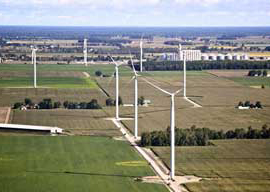 Counties involved in locally permitted, large-scale renewable energy projects may now apply for state awards from Michigan’s Department of Environment, Great Lakes and Energy.
An eligible project is a grid-connected wind, solar or battery storage project of at least 50 megawatts (MW) which received a local permit after Sept. 1, 2023, most commonly through special use or site plan approval.
The Renewables Ready Communities Award (RRCA) provides a local government $4,000 per MW permitted for. This award may be increased by 20 percent if the developer of the project establishes a satisfactory Project Labor Agreement for the construction of the project. If the host and permitter are separate (e.g., with county zoning), each local unit receives half of the award ($2,000 per MW.) This one-time award payment is made in full when construction begins on the project.
There are no requirements on how RRCA dollars can be spent. Prior awards have gone to various projects of public benefit such as new recreation equipment, town hall repairs, roadwork, cemetery upgrades, rooftop solar installations, consulting for master plan updates, contributions to fire department equipment purchases and more.
For additional details on this program, review EGLE’s summary.
Please contact EGLE through the RRCA website for details about eligibility, award amount determinations, Project Labor Agreement standards and more.
MAC opioid settlement services expand to include data and grant-making support
 MAC is pleased to announce an expansion to our wide array of free opioid settlement services to include data analysis and grant development assistance. Through funding provided by Michigan Department of Health and Human Services (MDHHS), we can request access to data that is typically available only at the state level to support your local opioid settlement efforts. This includes data on housing, treatment, overdoses, mental health and other social drivers of health. Our team can also help analyze this data alongside local sources to support needs assessments, program evaluation, strategic planning, and other opioid settlement-related initiatives.
In addition, MAC now offers direct support to counties seeking state opioid settlement grant funding. We can assist with evaluating grant opportunities, assessing project feasibility, and developing competitive grant applications including grant-writing support. We are also able to provide grant-writing support to local nonprofit partners working with your county on opioid settlement initiatives when requested by County government.
Our goal is to help counties maximize the impact of opioid settlement funds, strengthen local partnerships, and secure additional resources to address the opioid crisis in your community.
For more information on these services, contact Dan Kelly at kelly@micounties.org.
 |
 |
MAC on road: Staff visit UP counties, lead training event in Grayling
 MAC Executive Director Stephan Currie spent the week in the Upper Peninsula meeting with county commissioners in Baraga, Iron, Ontonagon, Gogebic (pictured left), Delta and Schoolcraft to brief them on MAC’s advocacy work and other services.
On Wednesday, Communications Director Derek Melot was in Grayling to help lead a New Commissioner School “Midterm” training event with MSU Extension. Governmental Affairs Director Deena Bosworth provided a State Capitol update via Zoom to the session.
Nearly 30 commissioners from 13 counties participated in the training, which earned them 1 credit for Year 2 certification in MAC’s County Commissioner Academy (CCA). For more information on CCA, click here.
 Staff picks
- Judge: Michigan should reject Consumers’ ‘highly problematic’ dam sale (Bridge Michigan)
- ‘Monumental’ upgrades at Michigan state parks are nearly complete — here’s where $273M went (MLive)
- Addressing the Stigma around Substance Use Disorders (Course for County Leaders) (JCOIN Training & Engagement Center)
- El Niño is here and rapidly strengthening. Here’s what it means for your weather (CNN)