
Nearly half the seats on MAC Board will be contested at 2025 Annual Conference
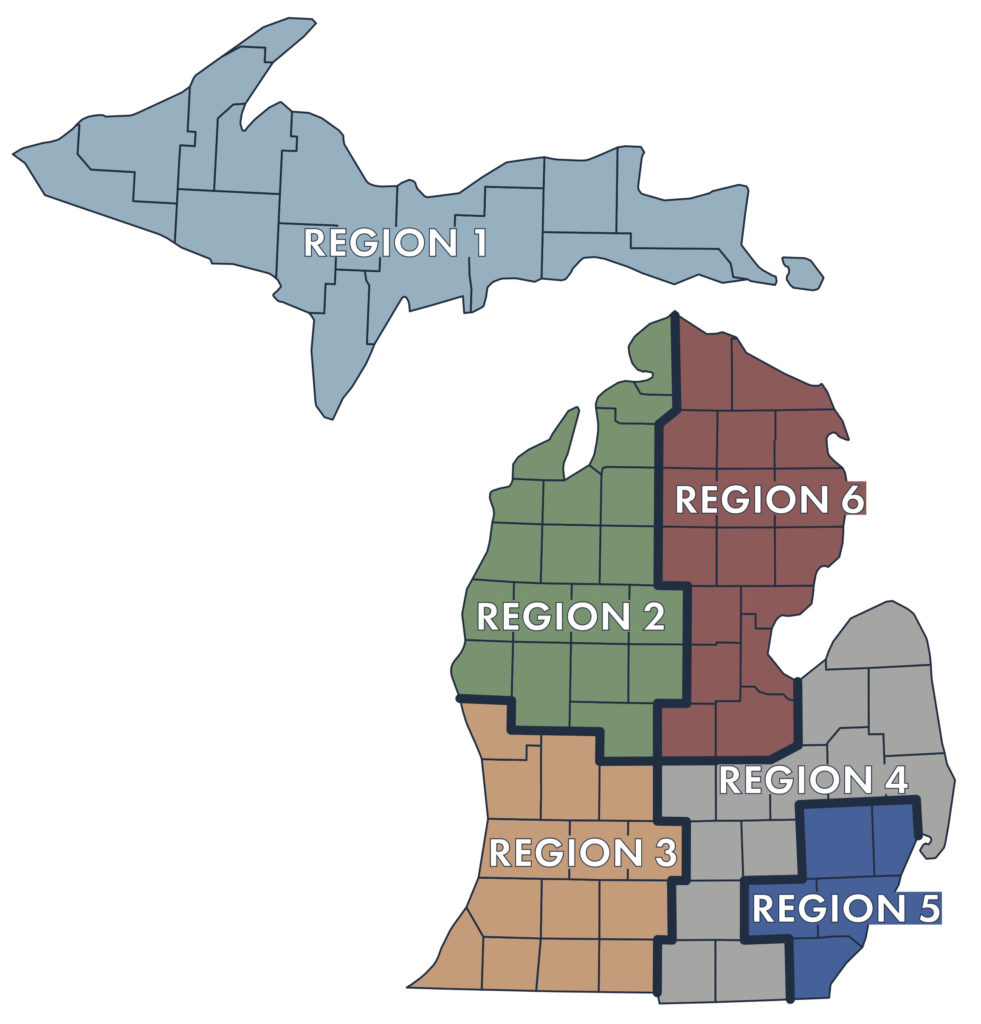 County commissioners interested in serving on the MAC Board of Directors have until Aug. 30, 2025, to file for elections to fill a whopping seven seats on the 16-member Board at the 2025 Michigan Counties Annual Conference.
The elections will be held on Oct. 1 at the conference at the Grand Traverse Resort. To be an official candidate, commissioners must file an official notice of their intent to run. Per MAC By-laws, applications are due by 4 p.m. on Aug. 30, 2025.
Six of the available seats represent regions, so they will be decided by a caucus in that specific region. The at-large seat is determined by votes from all six MAC regions.
To download an application form, click here.
“As far as we can tell, this will constitute the largest election slate for the MAC Board in decades,” said Executive Director Stephan Currie. “Combined with our annual approval of policy platforms for the coming year, these elections will make the 2025 conference one of the most impactful in many years.”
The MAC Board of Directors is the key body in guiding the legislative and organizational strategies of MAC. Board terms are three years in length and individuals may serve up to three terms.
The following seats are vacant and will be filled at the 2025 Annual Conference:
- Region I, Seat B (Open seat) (serves to September 2026)
- Region III, Seat B (Open seat) (serves to September 2026)
- Region IV, Seat A (Open seat)
- Region V, Seat A (Antoinette Wallace of Macomb County is the incumbent)
- Region VI, Seat A (Open seat)
- Region VI, Seat B (Donald O’Farrell of Iosco County is the incumbent)
- At-large, Seat B (William Miller of Oakland County is the incumbent)
No director shall serve more than three full three-year terms, except in certain situations where a director is filling a vacancy in an unexpired term. If the elected replacement shall serve more than half of the unexpired term, it shall be considered as if such person has served one full term for purposes of term limits. If the person filling the vacancy shall serve less than half of the unexpired term, that person shall be permitted to serve up to three additional full 3-year terms.
Candidates who file are also encouraged to submit a statement of up to 400 words on why members should support them. These statements will be posted to the MAC website in early September.
If you have any questions about Board duties, please contact Executive Director Stephan W. Currie at 517-372-5374 or scurrie@micounties.org.
Minimum staffing bill approved by Senate
 A bill to require minimum staffing levels as a mandatory subject of collective bargaining between a public employer and the representative of its employees was passed out of the Senate this week on a party-line vote. Senate Bill 319, by Sen. Veronica Klinefelt (D-Macomb), is a reintroduction of legislation from the previous legislative term, after MAC’s efforts stopped the bill from passing during the 2024 lame duck session.
SB 319 would amend the Public Employment Relations Act (PERA) and specifies that “other terms and conditions of employment” would include minimum staffing levels within the bargaining unit and consider minimum staffing levels a condition of employment with respect to a bargaining representative’s collective bargaining responsibilities. SB 319 would limit its application to only Public Act 312 employees, which was expanded to include corrections officers in 2024.
Making minimum staffing levels a mandatory topic of collective bargaining could increase staffing costs for counties. In addition to the potential for increased costs, many counties are facing staffing shortages. Implementing minimum staffing requirements when local governments are struggling to maintain fully staffed facilities will add to the difficulties counties already face when recruiting and retaining employees.
MAC opposes this legislation, as do the Michigan Municipal League, the Michigan Townships Association, and the Michigan Sheriffs’ Association.
For more information on this issue, contact Samantha Gibson at gibson@micounties.org.
Enbridge talks Line 5 progress, work across Michigan with Podcast 83
An energy transmission firm that operates in about 30 percent of Michigan counties is the focus of a new special episode of Podcast 83.
Paul Meneghini of Enbridge sat down digitally with host Stephan Currie to discuss Enbridge’s work across Michigan, including its plans for the Line 5 tunnel under the Straits of Mackinac.
“Obviously, what we’re most known for in Michigan is our crude oil or our liquids transportation system,” Meneghini said. “Line 5 is very well known in the state, but we do also operate three other liquids pipelines in the southern part of Michigan. …
“We operate the vector pipeline, which is a large interstate natural gas pipeline, which essentially starts in the northeast corner of the Chicagoland area and then goes around the south end of the lake and follows Interstate 94 … And then also the Nexus pipeline, which comes in from Ohio into the southeast part of the state and feeds some assets there in Michigan,” Meneghini explained.
“Most known in Michigan is our crude oil transportation network, which consists of Line 5 and then Line 78,” he continued.
Meneghini also noted that Michigan itself produces “12,000 to 14,000 barrels of crude oil” and much of it is moved through Line 5. “It is gathering about … 80 percent of Michigan’s produced crude oil and transferring it to market. That takes a lot of trucks off of the roads in rural parts of the northern Lower Peninsula.”
“You touched on a little bit on Line 5, and the tunnel has been a hot topic,” said Currie. “Can you give us any updates on where things stand with the tunnel and protecting that line?
“The tunnel project is really to make a safe pipeline safer at the end of the day. That pipeline is very, very heavily inspected, especially that four-mile crossing in the bottom of the Straits of Mackinac. I think it’s fair to say it’s the most inspected segment of over 100,000 miles of pipelines that we own and operate here in North America. …”
To learn details about the ongoing legal and regulatory issues on Line 5, plus what Enbridge does in the realm of community investment, watch the full episode by clicking here or on the image above.
Previous episodes can be seen at MAC’s YouTube Channel.
 MAC sets office schedule for Independence Day holiday
MAC’s Lansing offices will be closed on July 3-4 to observe the Independence Day holiday.
Regular office hours will resume on Monday, July 7 at 8 a.m.
Legislative Update emails will resume on Friday, July 11.
Barry County uses PACE program to create 135 housing units
 The Barry County PACE Program is now home to one of Michigan’s most substantial multifamily housing redevelopments using Property Assessed Clean Energy (PACE) financing: the Hastings Riverwalk Lofts, reports Lean and Green Michigan.
The Riverwalk Lofts consists of three newly constructed multifamily buildings, adding 135 residential units, with an additional building serving as a commercial market. The development revitalizes a vacant parcel along the Thornapple River which formerly housed the Hastings Table Company and Royal Coach Company warehouse.
Barry County and Lean & Green Michigan facilitated $4.39 million in PACE financing from Peachtree Group to help fund energy-related improvements to the development including upgrades to the building envelope, mechanical and HVAC systems, lighting, domestic water heating and water conservation components. In year one alone, these improvements are expected to save $155,469 in utility costs.
The Hastings Riverwalk Lofts is a perfect example, says Lean and Green, of how PACE financing can use a public-private partnership model to deliver results that are not only mutually beneficial for the property owner and local community, but that benefit us all by reducing carbon emissions and working towards a more sustainable future.
The PACE project at Hastings River Walk Lofts is expected to save 21,009,325 kWh of electricity or 14,115 metric tons of CO2 over the 25-year term. That’s the equivalent of eliminating the carbon impact of 1,588,290 gallons of gasoline consumed.
Click here to learn more about the project.
 Staff picks