
Key element of 2025 road funding plan failing to meet expectations
 Counties may see less road funding than anticipated this year as collections from Michigan’s newly enacted marijuana wholesale tax is significantly underperforming in early projections.
Public Act 16 of 2025, enacted on Oct. 8, 2025, created the Neighborhood Roads Fund as part of the state’s long-term transportation funding package. The new fund is supported by revenue from the Corporate Income Tax and a new 24 percent Marijuana Wholesale Tax. Lawmakers projected the marijuana tax would generate substantial revenue.
However, the first quarter of collections has raised concerns. Revenue from the marijuana wholesale tax was $34 million, well below the roughly $80 million that had been expected.
Beyond the shortfall, the tax itself still faces ongoing legal challenges, creating additional uncertainty about the long-term reliability of the revenue source. If collections continue to lag projections, dollars from the Neighborhood Roads Fund could be significantly lower than expected.
Many local governments are counting on additional transportation resources to address deteriorating roads and rising construction. While it’s too early to assess if this is a blip or a trend, county officials should closely monitor future revenue reports and state projections.
As implementation continues, MAC will monitor and advise members as needed.
For more information on this issue, contact Deena Bosworth at bosworth@micounties.org.
Effort to revamp mental health control opposed by MAC and others
 The House Health Policy Committee heard testimony this week on House Bill 6022, sponsored by Rep. Curt VanderWall (R-Mason), which would make significant changes to Michigan’s public behavioral health system by expanding the role of contracted health plans in pre-admission screening, hospitalization evaluations and care coordination activities currently performed by Community Mental Health Services Programs (CMHSPs).
MAC joined Community Mental Health Association of Michigan and other stakeholders in opposing the legislation, citing concerns that the proposal would create additional administrative barriers without improving access to care for individuals experiencing behavioral health crises.
Under current law, CMHSPs operate pre-admission screening units and serve as the single point of entry for individuals seeking inpatient psychiatric services. HB 6022 would allow contracted health plans and their delegates to operate pre-admission screening units and assume certain assessment and coordination responsibilities for individuals covered by those plans.
MAC and others argue this would fragment a system that is currently centralized within community mental health organizations. Rather than simplifying access to services, the bill could create additional paperwork, patient handoffs, administrative requirements and delays by involving multiple entities in processes that are currently coordinated through a single system.
Much of the committee’s discussion focused on a provision requiring assessments to be completed within three hours. Several committee members suggested that assessment delays are a primary reason individuals remain in hospital emergency departments while awaiting psychiatric treatment. However, opponents emphasized that the real challenge is not assessment completion times but the lack of available psychiatric beds and appropriate treatment placements.
Opponents further questioned the timing of the legislation. The Michigan Department of Health and Human Services recently announced a delay in implementation of the state’s Mental Health Framework, and the House-passed budget includes language prohibiting the department from expending funds to implement that framework. Given those developments, coalition members asked why legislation intended to operationalize elements of the framework is advancing before broader policy questions have been resolved.
The coalition urged lawmakers to slow the process and engage all affected stakeholders to identify meaningful reforms that improve access to care and strengthen the behavioral health system.
For more information on this issue, contact Deena Bosworth at bosworth@micounties.org.
Filing period opens for MAC Board elections at Annual Conference
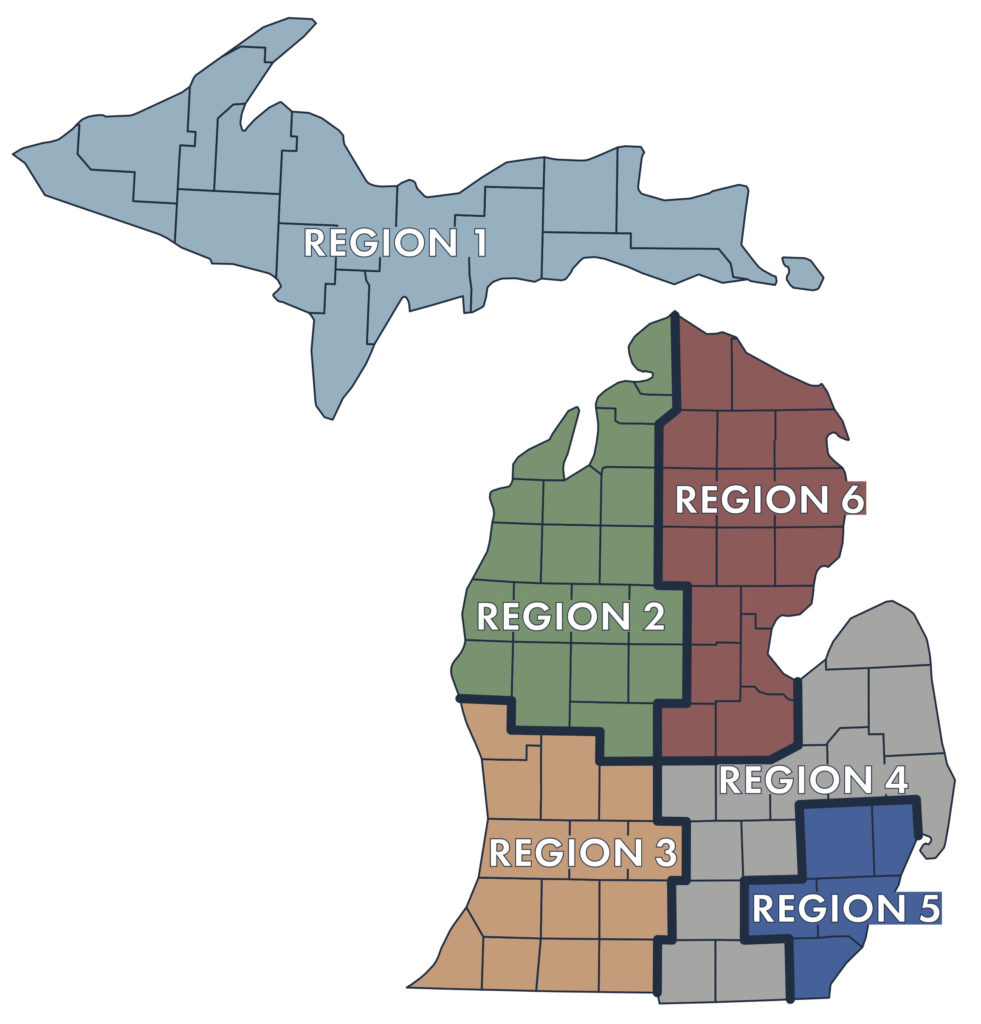 County commissioners interested in serving on the MAC Board of Directors have until Aug. 9 to file for elections to fill five seats on the Board at the 2026 Michigan Counties Annual Conference.
The elections will be held on Sept. 10 at the conference at the Grand Traverse Resort. To be an official candidate, commissioners must file official notice of their intent to run. Applications are due by 4 p.m. on Aug. 9.
Four seats available represent regions, so will be decided by a vote in that specific region. The at-large seat is determined by votes in all six MAC regions.
The MAC Board is the key body in guiding the legislative and organizational strategies of MAC. Board terms are three years and individuals may serve up to three terms.
Following seats will be filled at the 2026 Annual Conference:
- Region I, Seat B (Joe Derocha of Marquette County is the incumbent)
- Region II, Seat B (open)
- Region III, Seat B (open)
- Region IV, Seat B (Dwight Washington of Clinton County is the incumbent)
- At-large, Seat A (open)
Candidates are also encouraged to submit a statement of up to 400 words on why members should support them. These statements will be posted to the MAC website in mid-August.
If you have any questions about Board duties, contact Executive Director Stephan W. Currie at 517-372-5374 or scurrie@micounties.org.
Podcast 83 reviews big changes in opioid settlement work
The release of a long-awaited state list on unallowed spending items and the expansion of MAC’s consulting services for opioid settlements highlight comments from MAC’s opioid services leader in a special Podcast 83 episode.
“We have the new document that was released by the (Attorney General’s Office) which is really what we would call an ‘unallowable use’ list. So, items or services that are not considered opioid remediation and really do put counties at risk if they are purchasing those types of items,” explained Amy Dolinky, MAC’s director of opioid services.
“But just because an item is not on the list does not make it necessarily allowable,” she added. “So, the guidance that’s been put out is really more about how to think about expenditures.”
“What if they spent something that is now showing up on a list. Is there going to be a clawback?” asked host Stephan Currie. “Should there be concerns there?”
“We haven’t heard anything from the AG’s Office that explicitly states what will happen if a county has already purchased something that’s on the unallowable use list, but I would imagine they would be looking at all expenditures moving forward, and not necessarily be looking back, as that guidance did not previously exist.”
In the episode, Dolinky also discussed how a new partnership with the state Department of Health and Human Services provides a major boost to MAC’s assistance to members.
“We were able to onboard Dan (Kelly), our new technical assistance specialist. And with that role, we’re able to start some key projects. The first of those will be regional cohorts, where counties will have an opportunity to connect not just with each other but also with townships and cities … and really look at what are some regional needs that may exist.”
For more details about MAC’s opioid services, watch the full episode, recorded on May 29, by clicking here or on the image above. Or visit the Opioid Settlement Resource Center on MAC’s website.
MAC-backed bill on substance use disorder advances in House
 Legislation to preserve and strengthen a critical source of funding for county substance use disorder (SUD) programs across Michigan advanced in the House this week.
The House Economic Competitiveness Committee approved a substitute version of House Bill 5099, by Rep. Tyrone Carter (D-Wayne), that is supported by MAC.
Perhaps the most significant change in the legislation is the removal of the current sunset date, allowing the Convention Facility Development Fund distribution structure to continue indefinitely. Without this change, the future of an important revenue stream supporting county substance use disorder treatment and prevention services could be placed in jeopardy.
In 2025, counties received about $39 million from the fund for SUD programs.
The new version also makes an important but less obvious structural change to the flow of revenues within the fund. Now, liquor tax revenues would effectively pass directly to counties for SUD programming, while accommodations tax revenues would be used to satisfy debt service obligations associated with convention facility projects at Huntington Place in Detroit.
Debt service would continue to receive top priority, as required under existing bonding agreements. However, by shifting the funding source used for those obligations, the legislation helps ensure liquor tax revenues remain available to support SUD work.
HB 5099 moves to the full House for further consideration.
For more information on this issue, contact Deena Bosworth at bosworth@micounties.org.
Push begins for separate natural resources panel for the UP
 A legislative package to give the Upper Peninsula its own Natural Resources Commission was reviewed by a House committee this week.
House Bills 4783-86 would establish an Upper Peninsula Natural Resources Commission with powers like those now exercised by the statewide Natural Resources Commission. While the existing commission would retain authority over hunting and fishing regulations in the Lower Peninsula, the newly created Upper Peninsula panel would have exclusive authority over certain hunting and fishing matters affecting the UP.
The UP commission would have exclusive authority to regulate sport fishing in Upper Peninsula waters, including Lake Superior, the St. Marys River and inland lakes, streams, rivers, ponds and other bodies of water in the Upper Peninsula. In addition, the commission would have authority over hunting regulations, The panel would have 10 members appointed by the governor, with the advice and consent of the Senate. Appointments would be drawn from lists submitted by Upper Peninsula legislators, ensuring regional representation.
Supporters of the legislation argue UP residents face unique natural resource management challenges and decisions affecting the region’s hunting and fishing traditions should be made by individuals with direct knowledge of local conditions.
MAC filed a card of support for the bill package to the House Natural Resources and Tourism Committee. No vote was taken on the package.
For more information on this issue, contact Deena Bosworth at bosworth@micounties.org.
Apply by June 15 for grants for opioid treatment internships
 County leaders are encouraged to share information about a state internship program in the opioid treatment realm.
The Michigan Department of Health and Human Services (MDHHS) is accepting applications for the Michigan Opioid Treatment Access Internship Stipend Program, which provides financial support to students completing unpaid internships that lead to careers in substance use disorder (SUD) treatment and opioid recovery services.
Eligible students may receive stipends of up to $20,000, depending on the number of internship hours required. Internship placements must be unpaid.
The program is designed to expand Michigan’s substance use disorder treatment workforce. Applicants must sign a letter of intent indicating their commitment to serve Michigan residents and participate in program evaluation activities.
MDHHS has allocated $3.5 million, which could support up to 350 students. Funding is provided via resources from national opioid settlements.
Applications and supporting documentation are due June 15, 2026.
For assistance with any questions, contact Dan Kelly at kelly@micounties.org.
 Staff picks
- Medicaid work requirements are coming, Michigan and its residents need to prepare (Citizens Research Council)
- Michigan found a way to reduce school vaccine waivers. Until it backfired. (Kaiser Health News)
- BUILD America 250 Act looks good for county bridge funding prospects (NACo County News)
- National park deaths dropped in 2025 — but one demographic accounts for 84 percent of them (Outsideonline.com)