
FEMA’s future is among policy struggles on Capitol Hill, NACo reports
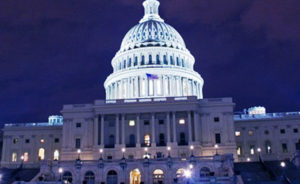 Convincing the Republican Congress and White House to continue the federal role in disaster response is one of just many efforts reaching a critical point in Washington, D.C., said the executive director of the National Association of Counties this week.
Matt Chase of NACo led a briefing on Thursday, June 5 with state associations and the need for county leaders to engage their members of Congress.
The FEMA (Federal Emergency Management Agency) Act is critical for counties, Chase said, as it enshrines the central role the federal government has long played in response to natural disasters.
However, the Trump administration has created a FEMA Review Council that’s looking into FEMA’s operations and potentially shifting responsibilities to states. It is scheduled to make a final proposal on Nov. 16.
In other disaster response news:
- The BRIC (Building Resilient Infrastructure and Communities) program has been canceled, Chase said, but may re-emerge with new criteria.
- A proposed increase to the per capita disaster indicator — to four times its current level — has stalled after the firing of the official who introduced the idea.
- The U.S. House Transportation and Infrastructure Committee released a draft bill that includes positive reforms, such as a proposed shift for public assistance from a reimbursement model to an upfront grant system with a 120-day payout timeline. This could significantly ease cash flow pressures for counties.
In other trending policy areas, NACo reported:
Sanctuary jurisdictions and ICE enforcement
The Department of Homeland Security (DHS) previously issued a list naming approximately 400 counties as “sanctuary jurisdictions” under an Executive Order aimed at “Protecting Americans from Criminal Aliens.” Though DHS has removed the list from its public website, it apparently remains in use and is expected to be managed going forward by the Department of Justice (DOJ). Federal funding eligibility is being threatened for those counties that remain designated as a sanctuary jurisdiction.
Keep in mind there is no legal definition of a “sanctuary jurisdiction” and no understanding as to what criteria were used to make this list.
Counties are advised to:
- Contact DHS at sanctuaryjurisdictions@hq.dhs.gov to request removal from the list.
- Engage congressional delegations for support.
- Develop a proactive media strategy, ideally using sheriffs or law enforcement as public spokespeople.
Fiscal 2026 federal budget
The president’s proposed FY 2026 budget includes significant cuts to nearly every domestic program relevant to county governments, Chase said. NACo will provide further analysis, but counties should begin preparing for constrained federal support across the board.
Medicaid and SNAP
Elements within the “OBBA” legislation that cleared the U.S. House by one vote recently raise major concerns for counties:
- Proposed Medicaid changes will increase the administrative burden at every step of the process for states and counties. Although no changes have been proposed to income eligibility, the documentation and administrative burden on those who qualify for them will increase. On top of the paperwork requirements, the bill cuts coverage for undocumented immigrants, reduces funding for CHIP and increases co-pays and work requirements.
- Administrative changes to the Supplemental Nutrition Assistance Program (SNAP) could shift the cost burden from a 50/50 federal-state split to a 75 percent state share, alongside more complex eligibility rules. These changes risk overwhelming local systems and discouraging participation.
Infrastructure
- Proposals for the federal highway trust fund include an annual $250 registration fee for electric vehicles and $100 for hybrids. This may be dropped due to procedural hurdles.
- A new Notice of Funding Opportunity (NOFO) from the Department of Commerce aims to streamline broadband rollout, possibly enabling projects to break ground within the year under the BEAD broadband program.
- The status of tax-exempt municipal bonds is maintained in the “OBBA” legislation.
For more information about MAC’s advocacy work, contact Deena Bosworth at bosworth@micounties.org.
‘Ban on bans’ bill for natural gas gets House Energy Committee hearing
 A bill to prohibit local units of government from imposing a ban on the use of natural gas or installation of natural gas infrastructure ― in other words, a “ban on bans” ― received a hearing in the House Energy Committee this week.
House Bill 4486, by Rep. Steve Frisbie (R-Calhoun), specifically prohibits a county, city, village or township from adopting an ordinance, resolution or policy that bans the use of natural gas or the installation of infrastructure to transport or distribute natural gas. Any ordinance adopted on or after the bill’s effective date would be unenforceable.
While House Republicans will most likely pass HB 4486, MAC does not anticipate the Senate advancing the legislation.
MAC opposes HB 4486 and all efforts to preempt local control.
For more information on this issue, contact Samantha Gibson at gibson@micounties.org.
County road purchasing requirements would change under House bill
 Legislation to increase the amount a county road commission or department can spend without requiring the purchase to be made through advertisement and sealed bids received a hearing in the House Transportation and Infrastructure Committee on Tuesday.
Currently, any purchase over $15,000, or $50,000 under emergency conditions, must be made via advertisement and sealed bid. Under House Bill 4415, by Rep. Tom Kuhn (R-Oakland), these thresholds would increase to $75,000 and $250,000. The bill requires the dollar amounts to be adjusted for inflation each fiscal year using the Detroit Consumer Price Index.
HB 4415 also would increase the weight threshold for purchases through advertising and sealed bid from 5,000 pounds to 10,000 pounds.
It has been several decades since this provision within county road law has been amended and adjusted for inflation and the increasing weight of vehicles utilized by road commissions and departments.
MAC supports HB 4415.
For any additional information on this issue, contact Samantha Gibson at gibson@micounties.org.
Bill to expand closed sessions gains Senate hearing
 Legislation to amend the Open Meetings Act (OMA) would expand allowable reasoning for a public body to hold a closed session to include a specific attorney consultation and the consideration of a claim, lawsuit, or criminal investigation concerning the body received a hearing in the Senate Local Government Committee this week.
Senate Bill 288, by Sen. Veronica Klinefelt (D-Macomb), is a reintroduction of SB 1023 from the previous legislative session.
MAC supports SB 288, as it allows county boards of commissioners to meet in closed sessions to discuss potential litigation and allows the board to have productive discussion about judicial matters.
For more information on this issue, contact Samantha Gibson at gibson@micounties.org.
Podcast 83 features new county resource for student loans
With the recent alert from the U.S. Department of Education about involuntary collections on student loans, a new MAC Service Corp. sponsored program is the subject of a timely special episode of Podcast 83.
Savi is the leading social impact company helping student loan borrowers manage repayment and apply for federal programs. Programs like income-driven repayment and Public Service Loan Forgiveness are available to county employees, explained Savi’s Tony Raffa.
“Savi helps borrowers navigate their student debt. We do this mostly by working with both employers and borrowers, and bringing this through employers to the borrowers, whether it be residents of a county or the employees of that county,” he said.
“When we started in 2017, we looked at a great program that’s available to all government employees, called Public Service Loan Forgiveness. Many of us were trying to get through that program ourselves and realizing how much of a challenge it was. In fact, in 2017, only 1 percent of applicants actually crossed the finish line of Public Service Loan Forgiveness.”
Michigan’s Oakland County is among the county adopters of this program, Raffa said. “We’ve been seeing some pretty amazing impact, and we’ve really been seeing this grow very rapidly through counties.”
For additional details from the conversation between Raffa and host Stephan Currie, please click on the image above or here.
Previous episodes can be seen at MAC’s YouTube Channel.
Next NACo briefing on federal impacts on counties will be June 12
 Join NACo’s Government Affairs team on June 12 for week three of “Inside Washington: County Impacts from the White House & Congress,” a biweekly series on key developments from the White House and Congress. Discussions will focus on policies and actions that directly impact counties — from federal funding and regulatory changes to intergovernmental partnerships.
Tune in for an inside look at how these evolving federal dynamics may shape county priorities, responsibilities and operations.
‘Fiscally Ready’ session will get into ‘nuts and bolts’ on June 16
 The Michigan Department of Treasury and Michigan State University Extension (MSU Extension) are reminding you of our next Fiscally Ready Communities training opportunity on June 16. This FREE training is a 90-minute webinar that’s designed to assist appointed and elected officials.
Click here to register. The webinar runs from 2 p.m. to 3:30 p.m. Eastern.
Nuts and Bolts: Fees, Fines, Purchasing and Receipting
Building a culture of fiscal sustainability is essential to local government fiscal health. Well-thought-out policies on fees, fines, purchasing, and receipting lead to clear rules and fair treatment, which are essential pillars to that culture of fiscal sustainability. This webinar will include a deep dive into best practices related to fees, fines, purchasing, receipting, and more. It will cover what they are, why such policies are necessary, how they contribute to local fiscal health, and how to get started on implementation.
What will be covered:
- Building a culture of fiscal sustainability
- Policy best practices for fee and fine structure
- Case study examples
- How strong receipting and purchasing practices strengthen local fiscal health
- Best practices for implementation
For more information about Fiscally Ready Communities, please check out the Treasury Fiscally Ready Communities webpage. This webpage includes Treasury’s 32-page Fiscally Ready Communities Best Practices document, which we encourage all local officials to review.
If you have any questions, please email TreasLocalGov@michigan.gov with the subject line “Fiscally Ready.”
 Staff picks
- Michigan court officials ask for juvenile facility to reopen amid community violence (Michigan Advance)
- Michigan DNR releases early findings in Upper Peninsula moose research project (WXYZ)
- Canadian wildfire smoke will be more frequent unwanted visitor in Michigan (Detroit Free Press)
- Hunt for clarity on BEAD’s future goes on (RouteFifty)