
Candidates finalized for MAC Board elections in September
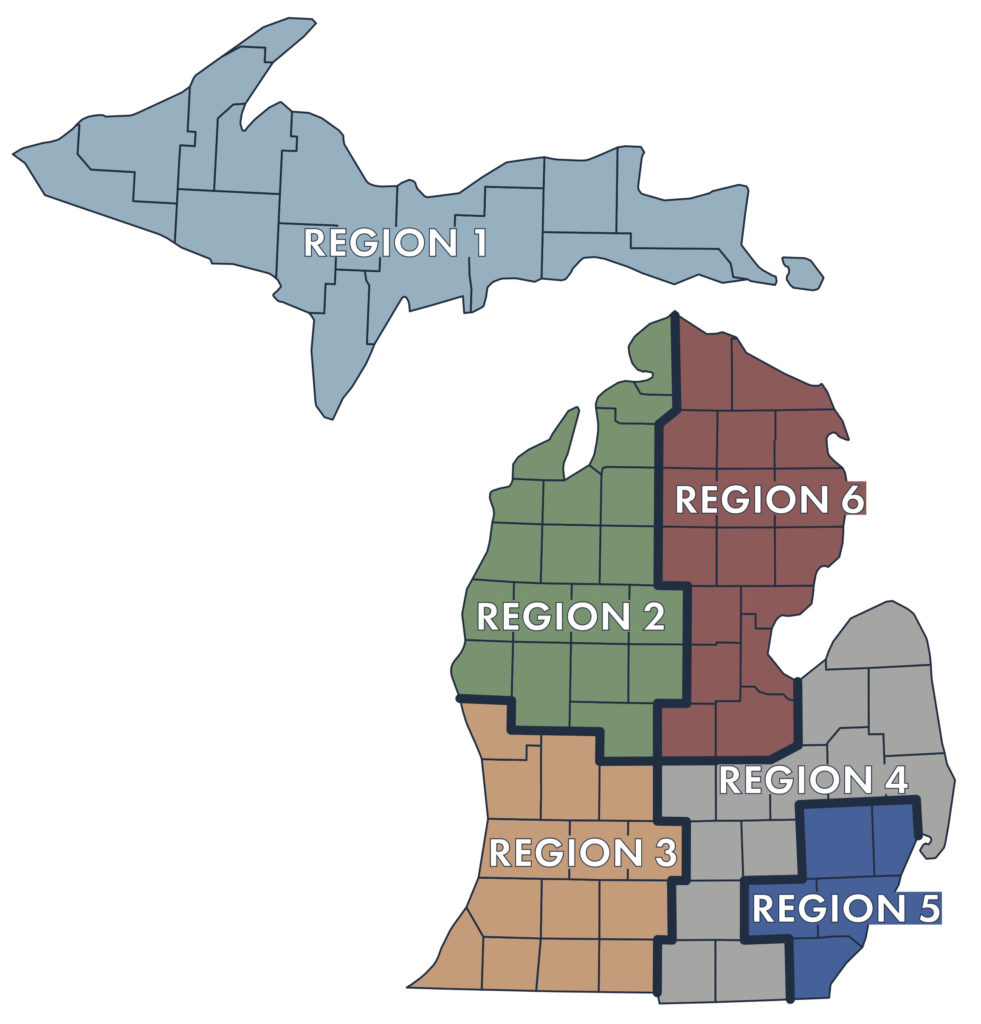 Six county commissioners will vie for five seats on the MAC Board of Directors during elections to be held at the 2026 Annual Conference.
The MAC Board is the key body in guiding the legislative and organizational strategies of MAC. Board terms are three years and individuals may serve up to three terms.
The only contested seat will be in Region 1 (Upper Peninsula) where the two eligible candidates are Joe Derocha of Marquette County and Craig Reiter of Schoolcraft County.
Candidates for the other four seats are:
- Region 2: Jeff Dontz of Manistee County
- Region 3: Josh Brugger of Ottawa County
- Region 4: Dwight Washington of Clinton County
- At-large: Gary Sauer of Benzie County
Uncontested candidates still must be formally approved by their various regions during regional caucuses to be held on Sept. 10 at the Grand Traverse Resort.
To see statements from the various candidates, click here.
For additional information on MAC’s voting process, click here.
Learn about rural health grants on Aug. 27 webinar
 Join the Michigan Association of Counties for an informative webinar featuring the Michigan Department of Health and Human Services on the Rural Health Transformation program (RHTP). This session will provide an overview of RHTP, the status of implementation and will outline how counties can engage with and benefit from RHTP.
The session will be on Aug. 27 from 11 a.m. to 12 p.m. Eastern.
Leading the session will be Beth Nagel, senior deputy director of the policy, planning and operational support administration for the Michigan Department of Health and Human Services.
RHTP is a federal program meant to improve the health of rural communities. Michigan will receive around $173 million of these dollars annually for the next five years with the goal of addressing such issues as chronic disease prevention, telehealth and recruitment of rural health professionals.
Governor adds voice to opposition to sale of Consumers Energy dams
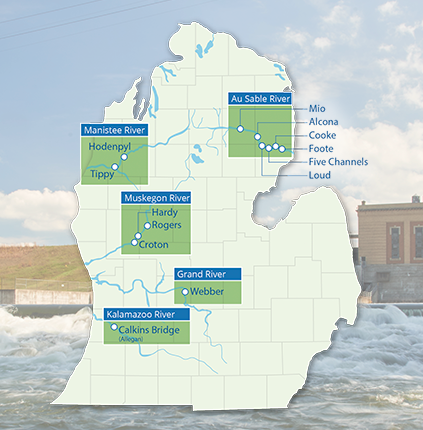
Map shows dams owned by Consumers Energy that the utility wishes to sell.
A controversial plan by Consumers Energy to sell 13 hydroelectric dams drew opposition from Gov. Gretchen Whitmer this week, as she formally urged the Michigan Public Service Commission (MPSC) to reject the proposed transaction, citing concerns about long-term dam safety and the potential for costs to ultimately fall on Michigan taxpayers.
MAC has been among those closely monitoring the ongoing regulatory review of Consumers’ plan this year.
Concerns among state officials center on the long-term responsibility for maintaining the dams. Earlier this year, the Michigan Department of Natural Resources (DNR) Director Scott Bowen said the dams could ultimately become a state liability if a new private owner is unable or unwilling to maintain them. The DNR subsequently intervened in the MPSC proceeding, and the Michigan Natural Resources Commission unanimously adopted a resolution opposing the proposed sale.
MAC does not have a position on the proposed sale itself. Our primary concern is what happens to these dams and the communities that depend on them regardless of who ultimately owns them.
Consumers Energy and Confluence have proposed a $270 million Hydro Safety Fund to address unforeseen long-term safety issues if the sale is approved.
Michigan’s counties cannot afford to see these dams deteriorate to the point where they become a public safety concern, an economic liability or a burden that ultimately falls to local governments. The state has already seen the consequences that can occur when aging dam infrastructure fails or requires significant intervention, such as with the Edenville and Sanford dams.
MAC remains focused on ensuring any future ownership arrangement provides the resources, accountability and long-term commitment necessary to maintain these dams and protect the communities that rely on them.
For more information on this issue, contact MAC’s Davis Grimm at grimm@micounties.org.
Contact your U.S. representative about federal funding rewrite
 County leaders are urged to contact their U.S. representative in the wake of Senate action that would delay a rewrite of federal grant rules opposed by the National Association of Counties (NACo) and MAC.
On Aug. 2, counties scored a win as the Senate passed a Continuing Resolution (CR) to fund the government through Dec. 11, which includes a provision delaying the Office of Management and Budget’s (OMB) proposed rewrite of the Uniform Guidance (2 CFR Part 200) until that same date — even if OMB finalizes the rule sooner. Without this provision, the rule would otherwise take effect Oct. 1, giving counties far less time to prepare for sweeping changes to how they administer federal grants.
The bill still must clear the U.S. House, however. NACo continues to speak with Congress and the administration to highlight the major impacts the rule would have on counties, and now needs House members to support the CR and the Uniform Guidance delay when they return. Read NACo’s policy update.
Contact your House Representative using NACo’s template letter and urge them to support the Senate CR, including the provision delaying OMB’s Uniform Guidance rule until Dec. 11. Visit NACo’s OMB Resource Hub for talking points and help contacting your U.S. representative.
Counties remain concerned about ‘Save America’ election legislation
 Actions taken on Capitol Hill prior to Congress’ summer break have complicated the issues around controversial election legislation, and counties still have plenty to worry about, reports the National Association of Counties (NACo).
Before recess, the House passed a budget resolution setting up a $95 billion reconciliation package (H. Con. Res. 113) that includes $10 billion in election-related grants tied to the SAVE America Act (H.R. 7296/S. 1383) provisions — separate from the National Defense Authorization Act (H.R. 8800) track the House used in July to attach the full SAVE America Act text, which would immediately mandate documentary proof of citizenship and photo ID requirements with no funding or transition period. The reconciliation path would instead fund a state grant program built around similar requirements, avoiding the NDAA’s immediate mandates but raising many of the same cost and capacity concerns long-term. The Senate path for both tracks remains uncertain, and NACo encourages members to reach out to their delegations during recess. View NACo’s SAVE America Act Resource Hub.
County leaders can use NACo’s template letter to share your county’s specific concerns about staffing, budget and voter services, and urge senators to remove or revise the election provisions in both bills, or at minimum ensure counties receive the time, resources and intergovernmental partnership needed to implement responsibly.
View NACo’s Save America Act Resource Hub for more resources.
State launches new matching fund program on opioid spending
 A new Local Government Opioid Settlement Matching Initiative partnering the state with local governments has been launched by the Michigan Department of Health and Human Services (MDHHS).
Counties and municipalities receiving opioid settlement funds may propose individual or regional projects for coordinated investment with MDHHS. Local governments must commit local opioid settlement funds to be eligible for state matching funds, with matching ratios varying based on factors including project category, demonstrated need, readiness and alignment with state priorities.
Projects should address identified local or regional needs and align with Michigan’s statewide substance use response framework. Funding may support planning, implementation or both, with priority given to proposals that address gaps in local services or infrastructure, use data to inform investments, build sustainable local capacity and demonstrate collaboration. MDHHS is particularly encouraging collaboration across jurisdictions, including partnerships among counties, cities and townships.
MDHHS will accept letters of intent on a rolling basis, with submissions due by 11:59 p.m. on the 15th of each month. Selected proposals may move forward into a more detailed application process.
MAC is providing technical assistance to local governments interested in pursuing this opportunity, including assistance with developing letters of intent. Communities considering an application or interested in discussing potential projects are encouraged to contact Dan Kelly, Technical Assistance Specialist, at kelly@micounties.org.
Catch up on special Podcast 83 episodes with procurement, opioid settlement experts
 Podcast 83 has entered its summer schedule of biweekly episodes, so members again have an opportunity this week to catch up on recent special episodes:
Aug. 4: Shawn Vaughn and Austin Brown of PPIM/CoProPlus joined podcast host Stephan Currie for an extended discussion of CoProPlus’ procurement services for counties and the evolving contract landscape in the public sector.
July 21: Ken Kelbel and Greg Watson of Nationwide, a longtime MAC partner, discuss the value of in-state staffing support for counties looking to streamline retirement options for employees.
June 30: Tony Raffa of Savi joined Podcast 83 to go over the huge changes to federal student loan programs on July 1 and discuss how Savi can help counties and their employees reduce their loan burdens.
June 2: Amy Dolinky, MAC’s director of opioid services, discusses the state of Michigan’s new list on proper spending targets for county opioid settlement funds and how MAC can guide members through these tough decisions.
You can find any episode of Podcast 83 by visiting MAC’s website.
Being ‘grant ready’ is theme of ‘Fiscally Ready’ webinar on Aug. 20
 The next “Fiscally Ready” webinar in the series from Michigan Department of Treasury and MSU Extension will be “Getting Grant Ready.” This FREE training will be held Aug. 20 from 10 a.m. to 12 p.m. Eastern.
This training helps local governments align grant opportunities with community goals, assess capacity to manage grants, and develop proactive policies and procedures. Participants will learn best practices for identifying, applying for, and managing grants to strengthen fiscal sustainability and maximize funding impact.
For more information about Fiscally Ready Communities, please check out the Treasury Fiscally Ready Communities webpage. This webpage includes Treasury’s 32-page Fiscally Ready Communities Best Practices document, which we encourage all local officials to review.
If you have any questions, contact TreasLocalGov@michigan.gov with the subject line “Fiscally Ready.”
 Staff picks
- Regulators call on Michigan to stop ‘endless’ cycle of yearly utility rate hikes (MLive)
- Mackinac Island council sets fall vote to expand ferry oversight (MLive)
- FEMA denies Michigan appeal for tornado aid (WMMT)
- How Influencers Are Rewriting the Rules of Estate Sales (Architectural Digest)