
Podcast 83 discusses new opioid reporting rules, Purdue settlement
 Counties now have new reporting requirements for their opioid settlement funds, said Assistant Attorney General Matt Walker in a special episode of Podcast 83 this week.
Those rules are a result of the new Purdue/Sackler settlement released publicly this month.
“These settlements are rather complicated from a legal standpoint, but they’ve been trying to make them as easy as possible for local governments to sign on to,” Walker explained. “There’s what I usually refer to as an implementation manager, and it’s a company named Rubris. They have a software program where they can push out DocuSign packages to local governments, and then so they get them in their email and they’re able to sign them via DocuSign.”
Beyond the funding, the Purdue settlement also sets new rules on reporting, beginning in fiscal 2026. To address what has been a long-standing challenge with opioid fund use, the Michigan Attorney General’s Office will provide guidance on what is appropriate or inappropriate expenditures.
“If you have a question, please email our opioids litigation box (AG-OpioidLitigation@michigan.gov) and we’re happy to respond,” Walker said.
Walker emphasized the importance of broad participation in this process to maximize the funding: “Participation is the key factor in how much money Michigan gets. So, the more participation, the more we get from the incentives in the structure of the settlement. … So please, if you have questions, ask, and please participate.”
To assist counties further, MAC will be hosting Walker in a special webinar on Aug. 21 from 3 p.m. to 4 p.m. (Eastern) to discuss the settlement details. To attend, you must register by using this link.
For general information on MAC’s opioid settlement work, contact Amy Dolinky at dolinky@micounties.org.
MAC offers resolution template on Purdue settlement
 In an effort to support local participation in the national opioid settlements, MAC has developed a resolution template to assist counties in authorizing their sign-on for the Purdue and Sackler family opioid settlement and to align with the amended Michigan State-Subdivision Agreement. This resource is designed to help counties meet the upcoming Sept. 30, 2025, deadline to sign on to the Purdue settlement and other related agreements, which are expected to bring an additional $7.4 billion nationally to support opioid remediation efforts.
The resolution template reflects updated requirements in the State–Subdivision Agreement, which now consolidates prior agreements and mandates annual reporting to the Michigan Department of Attorney General beginning in Fiscal Year 2026.
The new State-Subdivision Agreement outlines the ability for counties to seek guidance on allowable expenditures and promotes ongoing collaboration between the state and local governments. Counties should have received required documentation from Rubris, the Opioid Settlement Implementation Administrator.
For questions regarding the participation process, local governments are encouraged to contact their legal counsel, the Implementation Administrator at opioidsparticipation@rubris.com, or Assistant Attorney General Matt Walker at AG-OpioidLitigation@michigan.gov.
For technical assistance, contact MAC’s Amy Dolinky at dolinky@micounties.org.
Overdose deaths are declining but policy challenges remain
 Michigan is on track to record its third consecutive year of declining opioid overdose deaths. While this is not true for all populations in Michigan, local governments play a critical role in addressing the drug overdose crisis. As the federal and state funding landscape changes, many programs addressing substance use are experiencing funding cuts and uncertainty. Two counties in Michigan have implemented Emerging Needs Funds to be able to offer more timely and flexible access to funds in an attempt to support funding changes in the field.
On July 24, an executive order, “Ending Crime and Disorder on America’s Streets,” was issued by the Trump administration, highlighting changes in the harm reduction space. On July 29, the Substance Abuse and Mental Health Services Administration issued guidance on the executive order through a letter: Dear Colleague Letter: Executive Order on Ending Crime and Disorder on America’s Streets.
The National Association of Counties also has conducted an analysis of the executive order.
MAC is available to provide no-cost technical assistance to counties as they determine the best paths for planning and spending opioid settlement funds during this uncertain time of funding availability and service priorities. Since April, MAC has seen a notable increase in technical assistance requests.
Please reach out to dolinky@micounties.org for support with opioid settlement work.
Filing period for MAC Board elections closes in 2 weeks
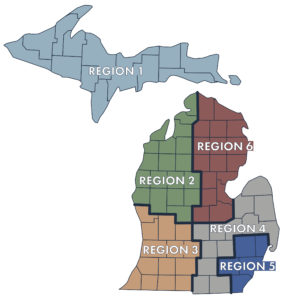 Only two weeks remain in the filing period for elections to fill nearly half the seats on the MAC Board of Directors.
Seven seats are in play for the 16-member Board at the 2025 Annual Conference. The deadline to file as a candidate is Aug. 30, 2025.
To date, 12 county commissioners have filed for election or re-election:
|
Region 1, Seat B |
Region 6, Seat A |
|
Kelli van Ginhoven, Delta |
Kathy Niemiec, Bay |
|
Region 3, Seat B |
Region 6, Seat B |
|
Julie Wuerfel, Berrien |
Jay O’Farrell, Iosco* |
|
Region 4, Seat A |
At-large, Seat B |
|
Brian Hurtekant, Clinton |
William Miller, Oakland* |
|
Region 5, Seat A Antoinette Wallace, Macomb* |
|
*Incumbent director
The elections will be held on Oct. 1 at the conference at the Grand Traverse Resort. Per MAC By-laws, applications are due by 4 p.m. on Aug. 30.
Six of the available seats represent regions, so they will be decided by a caucus in that specific region. The at-large seat is determined by votes from all six MAC regions.
To download an application form, click here. For questions about the election process, contact Communications Director Derek Melot at melot@micounties.org.
MAC partner Rehmann discusses energy tax credit work with counties
 How counties can use federal energy tax credits is the focus of a special episode of Podcast 83, featuring MAC Premier Partner Rehmann.
Tony Licavoli of Rehmann was interviewed by host Stephan Currie on the benefits for counties of credits under the 2022 Inflation Reduction Act and how time-pressed local leaders can most quickly navigate the rules.
These credits can be claimed by filing a federal tax return, using a modified form 990-T, Licavoli explained. Qualified projects include solar installations, geothermal HVAC systems, EV charging stations and EVs.
“I think one of the major misconceptions that we come across on some of these conversations is that these credits are only for large-scale projects,” Licavoli said. “You think about utility-type scale, but the ones that we work with the majority of the time are what we call smaller-scale projects. And these are typically the projects that we’re working with, with governmental entities.”
Credits can range up to 30 percent based on project size and can extend to 50 percent with additional requirements.
To learn more details about this option, and how Rehmann can assist you in pursuing it, click here to view the full episode, which was recorded in late April.
PFAS cost recovery option is now available
 Michigan counties have an important legal opportunity to recover costs associated with PFAS contamination in drinking water systems. This initiative is advancing rapidly: Settlement negotiations are now under way with the companies responsible for PFAS contamination, presenting a unique and time-limited chance for cost recovery.
The window, however, closes at the end of 2025.
Any public water system with a potential PFAS detection from September 2024 onward should take immediate steps to preserve eligibility. Airports and wastewater systems that have spent any funds on PFAS-related mitigation or remediation are also strongly encouraged to file. Failure to act before the deadline will mean missing out on this one-time opportunity.
Click here for a slide deck with more details on this initiative, or start your involvement in the settlement by visiting https://www.napolilaw.com/en/nccae/.
 Staff picks