
Board ships policy platforms to membership for Sept. 11 vote
 The MAC Board of Directors approved drafts of policy platforms for the 2026-2027 year at its session on Aug. 6.
This sets the stage for members to review and give final approval to the documents at the MAC Business Meeting, scheduled for 9:45 a.m. on Friday, Sept. 11 at the 2026 Michigan Counties Annual Conference.
Commissioners were sent a separate email earlier today that provides a link to the draft platforms for their review.
Per MAC’s By-laws:
“Section 6 Platform. A member wishing to submit an amendment to the MAC Platform shall submit the amendment to MAC at least five (5) days prior to the opening day of the MAC Annual Conference. Such amendment will require a majority vote at the annual meeting to be adopted. An amendment to the MAC Platform may be presented from the floor during the annual meeting. Such amendment will require a 2/3 majority vote of the members at the meeting at which a quorum is initially established to be adopted.”
These documents are developed each year by MAC’s internal policy committees staffed with county commissioners and other county leaders.
For any questions on the platforms, or if you are interested in joining a policy committee, contact Director of Governmental Affairs Deena Bosworth at bosworth@micounties.org.
Voters approve almost all county millage requests on Aug. 4
 Voters participating in the Aug. 4 primary elections approved nearly every county-related millage request on the ballot.
With the assistance of Gongwer News Service, MAC identified 141 separate county-related millage questions. In unofficial results, about 95 percent of those passed.
Among the more notable results from Tuesday:
- Iosco County voters renewed six existing millages and added a new levy for services to victims of abuse.
- Luce County voters renewed five existing millages and increased their millage for senior services.
- Midland County voters passed four millage increases for services ranging from road construction to dealing with spongy moth suppression.
Click here to see MAC’s millage tracker.
In what may have been the closest result of the night, voters in Benzie County defeated a request to set an operating millage rate of 5.8327 by nine votes, 3,409 to 3,400, in unofficial results.
Deadline to file for MAC Board elections is Sunday at 4 p.m.
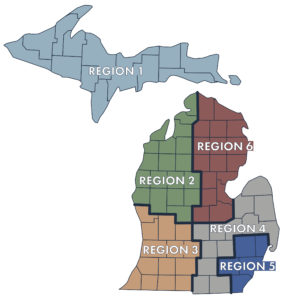 County commissioners interested in serving on the MAC Board of Directors have until Aug. 9 (this Sunday) to file for elections to fill five seats on the Board at the 2026 Michigan Counties Annual Conference.
The elections will be held on Sept. 10 at the conference at the Grand Traverse Resort. To be an official candidate, commissioners must file official notice of their intent to run. Applications are due by 4 p.m. on Aug. 9.
Four seats available represent regions, so will be decided by a vote in that specific region. The at-large seat is determined by votes in all six MAC regions.
The MAC Board is the key body in guiding the legislative and organizational strategies of MAC. Board terms are three years and individuals may serve up to three terms.
Following seats will be filled at the 2026 Annual Conference:
- Region I, Seat B (Joe Derocha of Marquette County is the incumbent)
- Region II, Seat B (open)
- Region III, Seat B (open)
- Region IV, Seat B (Dwight Washington of Clinton County is the incumbent)
- At-large, Seat A (open)
Candidates are also encouraged to submit a statement of up to 400 words on why members should support them. These statements will be posted to the MAC website in mid-August.
If you have any questions about Board duties, contact Executive Director Stephan W. Currie at 517-372-5374 or scurrie@micounties.org.
Podcast 83: Learn how CoProPlus can address your county procurement challenges
Helping county staffs address the conundrum of rising prices and limited procurement budgets is the focus of Podcast 83’s newest episode.
Shawn Vaughn and Austin Brown of PPIM/CoProPlus joined MAC’s Stephan Currie for a discussion on how their firms can help you keep the bills in check and the proverbial shelves stocked.
“The Public Procurement Institute of Michigan (is) a Michigan-based nonprofit … that exists to support people who are responsible for public purchasing, whether they’re public procurement professionals, a finance director, administrators, clerks or department leaders who wear multiple hats,” explained Vaughn.
“Let’s talk about that a little bit,” said Currie, “because there are varying capacities of government agencies out there. Some have procurement professionals, some don’t. So, what does your support look like in actual practice?”
“We’ve had to be very nimble and pivot, because the needs do change, of course,” replied Vaughn. “So, our goal is to make public procurement more accessible and less intimidating, especially for agencies with limited staff or limited procurement resources. We focus on three core areas: education, helpful resources and, my favorite, collaboration.
“One of our biggest priorities is providing that practical education that public agencies can put to use right away,” she continued. “A great example is our “Why It Matters” webinar series. So, rather than simply explaining procurement rules … We focus on why good procurement matters, and how it helps agencies make better decisions.”
“We’ve been a long proponent of CoProPlus,” said Currie. “I’ve worked with CoProPlus for a long time. Talk a little bit about the interaction between CoPro Plus and PPIM.”
“So, the PPIM ultimately is what exists to help public entities do the procurement that they want to do,” said Brown. “CoProPlus is the cooperative program and the vehicle that helps them do that. We’ve got about a little over 170 contracts that exist within our portfolio. And it’s a wide variety of different contracts that are available. So, a lot of what Shawn has mentioned is what PPIM is tasking people with: Can you procure more efficiently within your own organizations, whether that’s going through the bidding process or using resources that are already available to you. And then, sometimes that is looking at cooperative contract usage, and that’s where the CoPro Plus program exists.”
For more details, visit their website or watch the full episode, recorded in July, by clicking here.
 Staff picks
- Online prediction markets rile up state lawmakers (RouteFifty)
- Monroe County: A county that keeps on growing (Civil and Municipal)
- What to know before walking across the Gordie Howe Bridge (Bridge Michigan)
- How one man’s cure for loneliness started a movement (Wall Street Journal)