
What does a government shutdown look like?
 Reprinted with permission from MIRS News Service
Remembering the state government shutdowns of 2007 and 2009, attorney Steven Liedel recalls around 35,000 state employees being notified of layoffs pending a state budget deal, as well as the Governor’s office designating state-operated lift bridges to be left open.
During the four-hour shutdown of 2007, Liedel served as Gov. Jennifer Granholm’s deputy legal counsel. He served as her chief legal counsel in 2009 when the shutdown lasted two hours.
On today’s episode of the MIRS Monday podcast, Liedel described how it will be up to the governor to determine what remains open for the imminent protection of public health and safety.
A shutdown occurs when a budget deal is not struck and implemented in time for the start of the new fiscal year. This year in Lansing, a budget deal remains unseen while Fiscal Year (FY) 2026 begins in 37 days.
“There are no winners in that process politically, and obviously from a policy and real-world impact on people (perspective),” Liedel said. “Citizens are just used to the state government doing its job and staying out of its way for the most part. When that doesn’t happen, when you get kicked out of a campground, and you can’t register a used vehicle you may have bought from someone because the Secretary of State’s offices are closed, legislators tend to hear fairly quickly.”
He added that additional costs affiliated with shutting down can be incurred.
For example, a continuation budget might be signed ahead of the shutdown to ensure corrections officers are paid increased overtime to ensure prisons are staffed.
“For a few hours, particularly if it’s overnight hours, you have sort of the expenses that are incurred and diversions from other work to sort of prepare for that shutdown,” he said. “You may incur those obligations to make that pay, but until you have a budget, you may not be able to actually spend the state dollars to pay folks.”
Here are some points Liedel made about government shutdowns …
Podcast 83: State budget remains mired in Lansing politics
A fiscal 2026 state budget seems ever more distant, even as the start of that fiscal year and a possible government shutdown loom ever larger over Michigan.
That’s the assessment of MAC’s Podcast 83 team in its latest Legislative Update report from Lansing.
While all three players in the budget process (governor, House, Senate) now have advanced budget documents, the variances in them are massive and create far too much uncertainty for counties.
“We are not very happy at all with the House-passed version of the budget, especially when it comes to revenue sharing,” said Deena Bosworth. “And I want to be upset with many of our former county commissioners (now in the Legislature), but honestly, they didn’t have time to look at this budget. The House budget skipped votes in subcommittee, skipped votes in the full Appropriations Committee. It was discharged onto the House floor, and they had an hour to look over this budget, which is, I don’t even know how many pages, hundreds and hundreds … and they had an hour to vote on it.”
The House plan, in fact, would cut $35 million from county revenue sharing in FY26, as part of a bid to carve out hundreds of millions of dollars for road work.
It’s not all doom and gloom on budget particulars, so watch the full episode (recorded on Sept. 8) for details on public safety funding and more.
MAC continues to encourage county leaders to reach out to legislators to reverse the House’s bid to cut revenue sharing. Complete contact details can be found in our Advocacy Center.
 MAC Board candidates make their cases to members
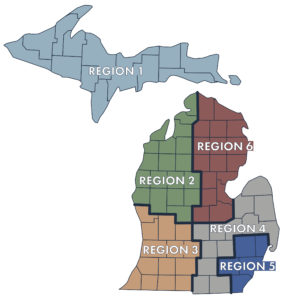
Official candidates for MAC’s Board elections at the 2025 Annual Conference were extended the opportunity to provide brief statements about why MAC members should support them.
Those statements are now available for member review on the MAC website.
Fourteen candidates filed for seven available seats (with three incumbent Board members running unopposed). The seats will be filled via regional caucuses held on Oct. 1 at 3:15 p.m. at the Grand Traverse Resort. To participate in a regional caucus, a county commissioner must be registered for the conference itself and be in attendance in the caucus room.
For questions about MAC election procedures, contact Communications Director Derek Melot at melot@micounties.org.
Consumers Energy to sell 13 dams across state
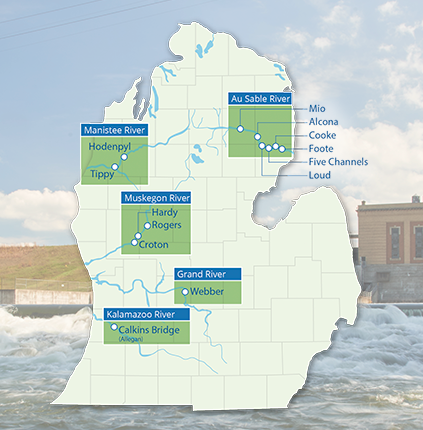 Consumers Energy will sell all 13 of its hydroelectric dams across Michigan to Confluence Hydro, a company specializing in dam operations. The move follows years of study on whether to keep, remove or transfer the dams, which generate only about 1 percent of Consumers’ total electricity but require significant investment.
As Consumers looked to end its dam ownership, counties such as Allegan and Newaygo had expressed concern about the fate of impoundments behind the utility’s dams and the properties around them.
Under the agreement, each dam will transfer for a symbolic $1, while Consumers continues purchasing the power and renewable energy credits for the next 30 years. The sale requires approval from state and federal regulators, which could take up to 18 months.
Confluence Hydro will be responsible for operations and maintaining reservoirs, though questions remain about environmental impacts, fish passage and the long-term costs of upkeep under private ownership.
While the sale is framed as reducing long-term costs for energy customers, it also shifts responsibility for major river infrastructure to new ownership — making county engagement and regulatory scrutiny essential.
For more information on this issue, contact Jimmy Johnson at Johnson@micounties.org.
MCMCFC finds House committee open to renewal of key funding stream

MCMCFC Executive Director Renee Beniak (right) testified on state funding this week along with the council’s advocacy team of Don Haney (left) and Jimmy Johnson.
A request to renew a key funding stream for county medical care facilities received a positive response from members of the House Insurance Committee this week.
The committee took testimony on House Bill 4726, by Rep. Matthew Bierlein (R-Tuscola), from the bill sponsor and leadership of the Michigan County Medical Care Facilities Council (MCMCFC), which represents more than 30 county-owned facilities.
HB 4726 keeps the current “Maintenance of Effort” (MOE) structure in place while the state studies options for a new funding model. Specifically, the bill:
- Extends the existing county MOE through Dec. 31, 2030, or until a new system is implemented, whichever comes first.
- Retains the $1 per-patient-day cap on annual increases to the county MOE rate.
- Makes no changes to resident eligibility or benefits.
MAC applauds Rep. Bierlein for introducing HB 4726 and for his leadership on a practical, bipartisan measure that supports stable operations at county medical care facilities and the seniors who rely on them.
A committee vote to advance the bill, a top MCMCFC legislative priority, could come as soon as next week.
For more information on this issue, contact Jimmy Johnson at Johnson@micounties.org.
DHHS director defends department in tense House session
 In a committee session sparked by a rare use of the House of Representatives’ subpoena power, state Health and Human Services Department (DHHS) Director Elizabeth Hertel was questioned intensely this week on her department’s actions in foster care, mental health and more.
While the department’s controversial RFP on managing mental health services was touched upon (a key issue for MAC), most of the discussion centered on the department’s handling of a 2023 case involving two children living in a tent. Members examined why the department concluded the case did not meet the statutory standard for abuse or neglect. Hertel said the law allows intervention only when there is evidence of harm or threatened harm — poverty alone does not meet that threshold.
A recurring theme in the session before the House Oversight Committee was the lack of psychiatric beds and the strain on child-caring institutions, which has left foster families managing children who really need residential treatment. Hertel acknowledged these challenges and said the department is open to partnering on facility expansion, though staffing remains a major barrier.
Questions also focused on error rates in Michigan’s Supplemental Nutrition Assistance Program (SNAP). The state rate remains higher than federal standards, which could lead to significant financial penalties starting in 2028. DHHS officials have noted recent budget reductions will make staffing — critical for preventing errors — even harder.
Hertel said her main priorities are expanding behavioral health access for kids, keeping families safely together whenever possible and improving operations and supporting staff.
Some committee members raised concerns about whether DHHS has enough resources to consistently follow up with families who don’t meet the current legal threshold for neglect.
For more information on MAC’s health and human services advocacy, contact Jimmy Johnson at Johnson@micounties.org.
Webinar co-sponsored by MAC fields questions about opioid settlement rules
 Michigan’s local governments will see more support from the state of Michigan in how to properly deploy opioid settlement funds, an assistant attorney general noted in a webinar co-sponsored by MAC and the Michigan Townships Association.
Matt Walker of the Attorney General’s Office led webinar attendees through the details of the new Purdue/Sackler settlement and the unique changes it brings to Michigan local governments now receiving settlement funds.
“One thing that this updated agreement does is that it combines all the previous agreements that we had down into one document,” Walker explained. “The other big portions are that it ―no. 1 ― allows local governments to ask the AG’s Office for generalized guidance about the settlements, the State-subdivision Agreement or whether a proposed expenditure would qualify as opioid remediation.
“So I sort of truncated the language here a bit, but the one thing to know is that it also allows the AG’s Office to do that on its own, too, so that we could issue generalized guidance about any one of these topics if the need arose.”
The Purdue Sackler settlement involves $7.4 billion nationwide, with Michigan expected to receive $154 million over 15 years. Michigan governments are slated to receive $1.8 billion by 2040. The settlement funds must be used for opioid remediation, with 70 percent for future initiatives.
‘Fiscally Ready’ session will help you become ‘grant ready’
 The Michigan Department of Treasury and Michigan State University Extension (MSU Extension) want to make you aware of our newest Fiscally Ready Communities training opportunity, Getting Grant Ready, on Sept. 25. This FREE training is a 90-minute webinar that’s designed to assist appointed and elected officials.
Getting Grant Ready
This training helps local governments align grant opportunities with community goals, assess capacity to manage grants, and develop proactive policies and procedures. Participants will learn best practices for identifying, applying for and managing grants to strengthen fiscal sustainability and maximize funding impact.
This free webinar will run three times this fall:
- Sept. 25 from 10 a.m. to 11:30 a.m. Eastern
- Oct. 20 from 2 p.m. to 3:30 p.m. Eastern
- Dec. 4 from 10 a.m. to 11:30 a.m. Eastern
For more information about Fiscally Ready Communities, please check out the Treasury Fiscally Ready Communities webpage. This webpage includes Treasury’s 32-page Fiscally Ready Communities Best Practices document, which we encourage all local officials to review.
If you have any questions, email TreasLocalGov@michigan.gov with the subject line “Fiscally Ready.”
 Staff picks
- Berrien County Public Defenders’ Office seeks higher pay, retention (Herald-Palladium)
- Blue states hold on to public health dollars while red states lose out (Stateline.org)
- Whitmer admin ‘contingency’ planning for potential Michigan government shutdown (Bridge Michigan)
- Police departments lower education standards due to staff shortages (Governing)