
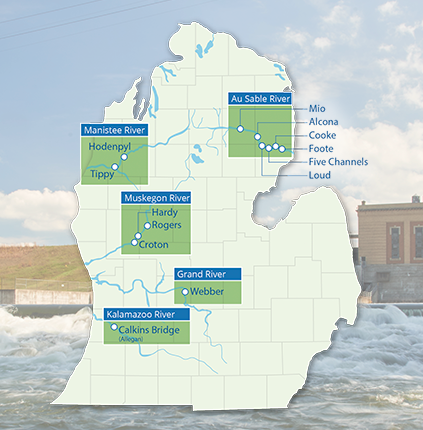
Map shows dams owned by Consumers Energy that the utility wishes to sell.
With a potential ownership change for more than a dozen dams looming, the Senate took testimony on legislation to inject more state scrutiny of this infrastructure.
Senate Bill 627, by Sen. Jon Bumstead (R-Muskegon), would require additional financial scrutiny when hydroelectric facilities are sold or transferred in Michigan. The bill comes as state regulators continue reviewing Consumers Energy’s proposed sale of 13 hydroelectric dams to Confluence Hydro.
Under current law, the Michigan Public Service Commission (MPSC) must approve the sale, acquisition, merger or transfer of regulated utility assets and evaluate whether a transaction is consistent with the public interest. SB 627 would add specific requirements for hydroelectric facilities by requiring the MPSC to determine whether a prospective owner has both the financial capacity and intent to safely operate, maintain, and ultimately decommission or remove a facility if necessary.
Specifically, the bill would require the MPSC to consider whether an acquiring entity can provide for:
- Capital investments necessary to maintain safe and efficient operation of the facility throughout its lifespan
- Damages resulting from a complete structural failure of the facility
- Future decommissioning or dam removal costs
- Other factors deemed necessary by the Commission
The legislation is being considered against the backdrop of the proposed transfer of 13 Consumers Energy hydroelectric dams to Confluence Hydro. During the ongoing regulatory review, MPSC staff, the Michigan Department of Attorney General and the Michigan Department of Natural Resources have raised concerns regarding the transaction.
Among the issues identified by reviewing agencies are:
- The lack of assurances that Confluence Hydro would retain ownership in the long term
- The possibility the dams could be sold again to owners with fewer financial resources
- Questions regarding the financial capacity for future maintenance and eventual decommissioning
- Concerns that taxpayers could ultimately be responsible for dam-related liabilities if a future owner becomes insolvent
- Long-term safety, stewardship, and infrastructure management concerns associated with aging dam facilities
Several parties participating in the regulatory proceedings have recommended that any approval include conditions such as financial assurances, restrictions on future ownership transfers, and parent-company guarantees. Consumers Energy has indicated that it is unwilling to proceed with the transaction if significant conditions are imposed.
Background on proposed sale
- 2022: Consumers Energy begins evaluating long-term options for its hydroelectric assets.
- September 2025: Consumers Energy announces an agreement to sell 13 hydroelectric dams to Confluence Hydro.
- Late 2025–2026: Regulatory review proceedings begin before the MPSC and the Federal Energy Regulatory Commission (FERC).
- June 2026: An Administrative Law Judge recommends that the MPSC reject the proposed transaction.
- Summer/Fall 2026: The MPSC is expected to issue a final decision regarding the proposed sale.
Potential outcomes
If approved, ownership of the hydroelectric facilities would be transferred to Confluence Hydro following completion of state and federal regulatory approvals.
If the MPSC rejects the transaction, or if conditions imposed by regulators are unacceptable to Consumers Energy and Confluence Hydro, Consumers Energy has indicated it may pursue decommissioning and removal of some or all of the dams.
Supporters of SB 627 argue the legislation would provide the MPSC with clearer authority to evaluate the long-term financial viability of prospective dam owners before approving a transfer. As Michigan continues to confront the challenges of aging infrastructure, the bill represents an effort to ensure that ownership changes do not create future public safety risks or unfunded financial obligations for residents, local governments and taxpayers.
MAC position
MAC has not taken a position on SB 627 but urges county leaders to stay informed on the topic.
For more information on this issue, contact Deena Bosworth at bosworth@micounties.org.