
Dam safety regs affecting counties near enactment in Lansing
 More than 100 county-owned dams would face new safety requirements under two bills on the brink of being sent to the governor for her signature.
House Bill 5485, by Rep. Bill Schuette (R-Midland), passed this week, while Senate Bill 947, by Sen. Mallory McMorrow (D-Oakland), passed last week. The House must concur with Senate changes made to HB 5485 before the bills go to Gov. Gretchen Whitmer.
There are 357 county-owned dams statewide, with 113 expected to fall under the new requirements. Of those, 63 are classified as “high- or significant-hazard” dams and will face some of the legislation’s most stringent rules. The bills establish new dam registration requirements, asset management and maintenance plans, more frequent inspections for high- and significant-hazard dams, comprehensive evaluations and updated emergency action plans.
Click here for the statewide dam inventory map.
MAC supports efforts to improve dam safety, but the new requirements must be accompanied by adequate and sustainable state resources.
MAC has worked to ensure the legislation recognized the unique challenges facing counties that own dams. MAC gained a 5-year grace period for dams acquired by a county through tax foreclosure, for example, providing counties time to assess the condition and long-term viability of a dam before being exposed to certain state regulations.
MAC also urged that the focus of the most significant new requirements be on dams that pose the greatest risk to public safety.
And MAC secured a $20 million legislative transfer for dam repair, alteration, removal and other activities necessary to address risks associated with high-hazard, significant-hazard and poor-condition dams and will continue working toward a long-term funding strategy.
For more information on this issue, contact Davis Grimm at grimm@micounties.org.
Senate committee reviews bills on Open Meetings Act, election payments
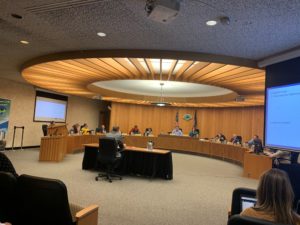 Bills supported by MAC on public meeting rules and election aid received hearings before the Senate Committee on Elections and Ethics this week.
Senate Bill 271, by Sen. Ed McBroom (R-Dickinson), would amend the Open Meetings Act to allow public officials to participate in public meetings remotely. Such participation would be allowed if a quorum of the body’s members is physically present at the meeting location. Members attending remotely could participate in discussions and deliberations, but they would not be permitted to vote.
Senate Bill 1186, by Sen. Chedrick Greene (D-Bay), would require the state to reimburse a county, city or township for the costs of conducting a special election to fill a vacancy in the office of state senator or state representative when the special election is held on a date other than a regularly scheduled election date.
The committee did not vote on either bill, but further consideration of them is expected. To view testimony on these bills, click here.
For more information on these bills, contact Maci Main at mmain@micounties.org.
MAC releases webinar on county budgeting process
 Video and slides from a County Commissioner Academy webinar in August are now available to all MAC members.
“Understanding the County Budget Process” was held on Aug. 19 for commissioners who had registered for credit in the academy, MAC’s continuing education program.
The presentation covered key elements of the county budget process, including:
- the role of commissioners, staff, and residents in the process;
- how fund accounting and other fiscal rules shape decisions;
- how state laws and regulations affect the budget process; and
- tradeoffs to consider for county operations, capital spending and debt.
Dr. Erika Rosebrook, director of the Michigan State University Extension Center for Local Government Finance and Policy, led the one-hour session. Rosebrook’s research centers on the relationship between state and local governments and how residents engage with local governments. Prior to arriving at MSU, she was an assistant county administrator in Ottawa County and worked as a management analyst in the Kent County Administrator’s Office.
Click here to watch the session on MAC’s YouTube channel.
Click here for the slides provided by Dr. Rosebrook.
Podcast 83: As legislative work winds down, MAC continues push on county priorities in 2026
MAC’s Podcast 83 discussed what appears to be a shrinking legislative work calendar and how that affects remaining county priorities in 2026 in a new episode.
“We had a little bit of legislative activity last week, and it’s probably going to be spotty going forward now until at least till the election, but let’s touch on what they did work on,” said host Stephan Currie.
“Senate Bill 947 finally moved through the House last week,” replied Davis Grimm. “That bill changes some of the inspection requirements and registration requirements around dams. … It is going to impact dams across the state.
“We’re looking at roughly 360 county-owned dams across the state, and 60 of those are listed as higher significant hazards,” he added, “so, they’re going to see almost triple the number of inspections required. …
“For counties like Gladwin, who own close to eight dams, and two of which being high hazard … they’re going to see probably a $30,000 increase in inspection costs alone …”
Also covered in this week’s episode:
Indigency standards – “(Senators) heard testimony last week on Senate Bills 1089, 1090 and 1091 in the Senate Judiciary Committee, and they were voted out of the committee,” said Maci Main.
“What those bills would do is create a statewide process for determining indigency,” she continued. “So, if that person is determined indigent, they would then not be able to impose certain costs, fees and assessments on those defendants. Our concern with the bills isn’t necessarily the indigency determination factor of it. It’s the fact that revenues might be lost in that process.”
Lake assessments – “When the (Department of Natural Resources) owns a boat ramp, or a campground, or a parking lot, they have an obligation to help pay for that lake level maintenance or the establishment of a lake level, and all the costs that are incurred in it,” explained Deena Bosworth. “Although they’re statutorily obligated to pay it, back in 2022, there was some legislation that kind of monkeyed around with that, and now the state is taking their financial responsibility for their portion of those assessments out of county and township PILT payments. And that’s absolutely not OK. So, Rep. Tom Kunse (R-Clare) introduced House Bill 6105 for us, and that bill would just take it back to the previous way of handling this.”
For more details on these bills, watch the full episode, recorded on Sept. 28, by clicking here or on the image above.
 The Michigan Association of Counties is expanding its opioid settlement technical assistance program to support Michigan cities and townships that receive direct opioid settlement funds.
Building on its work with Michigan’s 83 counties, MAC will now provide resources, training and technical assistance to all local governments across the state to help communities maximize the impact of opioid settlement investments. The expanded program will continue to offer practical tools and guidance on planning, decision-making, implementation, reporting and transparency.
As Michigan communities continue making critical decisions about opioid settlement funding, MAC’s goal is to ensure local governments have access to the expertise and resources needed to invest settlement dollars effectively and sustainably.
For questions, contact Amy Dolinky at dolinky@micounties.org.
BCBS of Michigan releases seasonal flu toolkit
 Because flu season typically peaks between October and May, Blue Cross Blue Shield of Michigan, a MAC Premier Partner, has released its 2026-2027 Flu Shot Toolkit.
“From Oct.1, 2025, through May 23, 2026, the Centers for Disease Control and Prevention estimates there have been 32 million to 57 million people sick with the flu, resulting in 390,000 to 800,000 hospitalizations and 24,000 to 81,000 flu deaths,” the document states.
“The most effective way to protect yourself and others during the peak flu season, between October and May, is by getting your annual flu shot,” it added.
The toolkit includes flu shot guidelines, ready-to-use social media content and downloadable graphics that counties can use to educate and encourage their work forces. Flu vaccination remains one of the best ways to help protect against severe illness, especially for children, older adults and individuals with chronic health conditions.
For more information about Blue Cross’ services for county governments, visit their webpage at micounties.org.
State housing authority seeks input on ‘the future of housing’
 The Michigan State Housing Development Authority (MSHDA) invites all Michiganders 18 years of age or older to help shape the future of housing in Michigan by participating in a public survey.
SHP 2.0 will be a collaborative blueprint that builds on the progress of the state’s first housing plan released in 2022. Public input will play a central role in developing the new plan and help inform goals and strategies for the years ahead.
The survey responses will supplement what we receive through various engagement activities, such as regional listening sessions, interviews, community events, storytelling sessions and focus groups.
Take the survey at https://www.surveymonkey.com/r/353RD8F
The State of Michigan is committed to providing meaningful access to the Statewide Housing Survey. If you need accommodations, translation, interpretation or other assistance to participate in this survey, please contact the Michigan State Housing Development Authority (MSHDA) at 855-646-7432 or MSHDA-MISHP@michigan.gov.
 Staff picks